


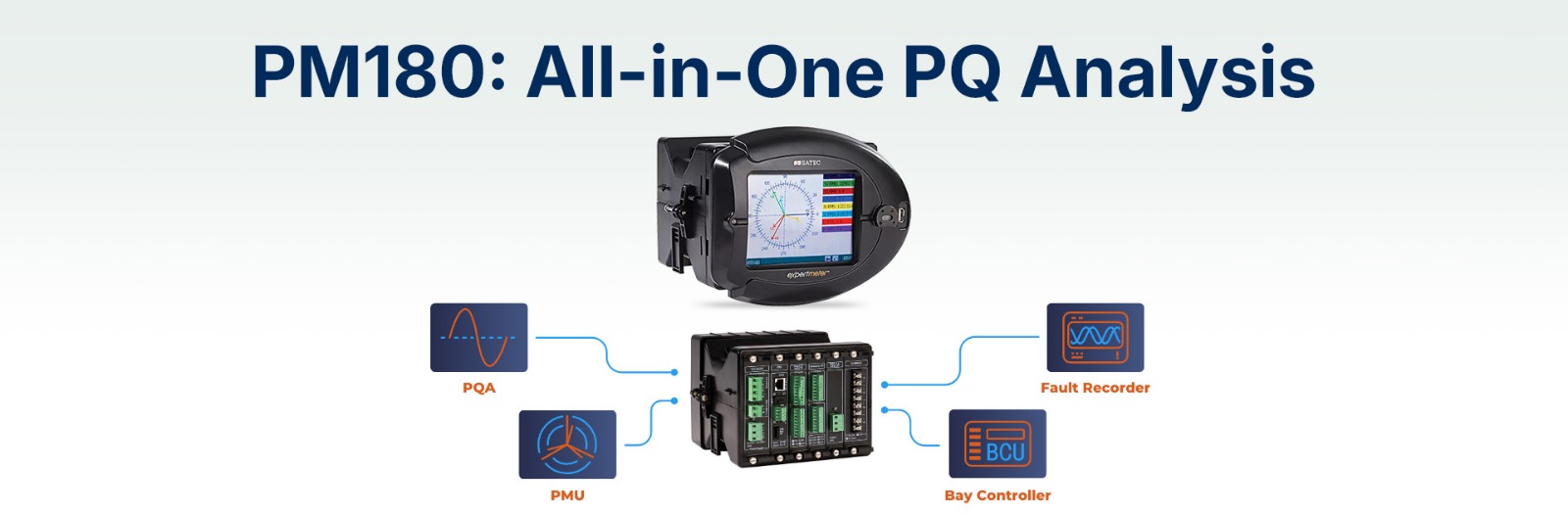
Power quality issues in cost utilities and customers every year- equipment failures, production losses, and customer complaints. Voltage sags cause computer crashes. Harmonics are damaging transformers.
Finding and fixing these problems requires proper measurement tools. But utilities face a challenge. They need a comprehensive analysis without carrying multiple devices. They need accurate data without a complicated setup. They need reliable equipment that works in harsh field conditions.
That’s where PM180 works. This Power Quality Analyzer combines comprehensive measurement capabilities with practical field usability in a single compact device.
In this article, we’ll explore what makes PM180 an ideal solution for utility power quality work. Not marketing claims. Real features that matter when you’re troubleshooting problems in substations and on poles.
Utility engineers deal with power quality issues constantly. The customer complains about flickering lights. Industrial client reports frequent drive failures. Equipment at the substation is running hot.
Each problem needs investigation. What’s causing it? Where exactly is the problem occurring? How severe is it? How to fix it?
The traditional approach means carrying multiple instruments. Multimeter for basic measurements. Oscilloscope for waveforms. Harmonic Analyzer for distortion. Flicker meter. Data logger.
Problems with this approach:
Too much equipment. Multiple devices mean heavy bags. More setup time. More things to go wrong.
Inconsistent data: Different devices measure at different times. Hard to correlate measurements from multiple tools.
Limited capabilities: Basic meters miss important parameters. You might measure voltage, but miss harmonics, causing the actual problem.
Complex operation: Each device has a different interface. Learning and remembering multiple systems wastes time.
You can’t fix power quality problems if your measurement tools are themselves a problem.
Modern utilities need a single device that does everything. That’s exactly what PM180 delivers.
PM180 is designed specifically for utility power quality work. It’s not adapted from laboratory equipment. Not simplified from industrial automation tools. Built from the ground up for field engineers.
One device measures everything you need:
Voltage and current: RMS values, waveforms, min/max, with high accuracy across a wide range.
Harmonics analysis: Up to 63rd harmonic for both voltage and current. See exactly what frequencies are polluting your system.
Power parameters: Active, reactive, and apparent power. Power factor. Energy consumption. All phases simultaneously.
Transients and events: Captures voltage sags, swells, and interruptions. It records exact duration and magnitude.
Flicker measurement: Quantifies voltage fluctuations causing light flicker complaints.
Unbalance: Measures phase imbalance that causes motor overheating and neutral current problems.
This comprehensive capability means one Power Quality Analyzer replaces a rack full of specialised equipment.
Lab instruments don’t survive utility field work. PM180 is built for real conditions:
Rugged construction: Withstands drops, vibration, and temperature extremes. Works in dusty substations and outdoor installations.
Long battery life: Full shift of measurements without recharging. Critical when working at remote sites.
Bright display: Readable in direct sunlight. Many analysts fail this basic requirement.
Simple interface: Intuitive operation without constant reference to the manual. Field engineers learn it quickly.
Compact size: Fits in a tool bag without taking entire space. Light enough to carry up poles or into cramped equipment rooms.
Power quality problems are often intermittent. They happen at random times, not when the engineer is watching.
PM180 logs data continuously:
Large memory: Weeks of detailed measurements stored internally. Catch problems whenever they occur.
Triggered recording: Set thresholds for voltage, harmonics, or other parameters. The device captures events automatically when limits are exceeded.
Timestamp accuracy: Each measurement includes an exact time stamp. Correlate power quality events with customer complaints or equipment failures.
Easy data export: Transfer recorded data to a computer for detailed analysis and reporting. Standard file formats work with common analysis software.
Let’s look at specific utility problems PM180 helps solve.
Customer calls saying their computers keep resetting. It could be voltage sags. Could be harmonics. Could be transients.
Install PM180 at the customer’s service entrance. Let it log for a few days. The device captures every disturbance with exact timing and characteristics.
Analysis shows brief voltage sags from nearby motor starting. Problem identified. Solution: install a voltage regulator or soft starter on the motor. Customer happy.
The substation transformer is running hot. Load seems normal. What’s wrong?
Connect the PM180 to check the load current and its harmonics. It reveals high 5th- and 7th-harmonic content from nearby industrial loads.
These harmonics cause additional heating beyond what the load current alone suggests. Solution: install a harmonic filter. Transformer temperature returns to normal.
The neutral conductor on the distribution feeder is overheating. Safety concern.
Power Quality Analyzer measurement reveals severe phase unbalance and high harmonic content. Both contribute to excessive neutral current.
Utility rebalances loads across phases and addresses harmonic sources. Neutral current drops to safe levels.
The utility is experiencing frequent capacitor bank failures. Expensive and frustrating.
PM180 measurements show high harmonic distortion at the capacitor location. Harmonics cause overvoltage and overcurrent on capacitor banks, leading to premature failure.
Solution: relocate capacitors away from harmonic sources or add detuning reactors. Failure rate drops dramatically.
Utility needs to verify power quality meets regulatory standards. Manual spot checks are inadequate.
Deploy PM180 for continuous monitoring at key locations. Automated logging provides comprehensive records proving compliance. Or identifies violations before regulators find them.
Based on feedback from utility engineers, several factors make PM180 the preferred choice:
Does everything needed: One device for all common power quality investigations. No need for multiple specialised tools.
Survives field conditions: Reliable in rain, dust, heat, and cold. Doesn’t require delicate handling.
Simple to use: New technicians become productive quickly. Experienced engineers work faster.
Accurate and reliable: Measurements you can trust for critical decisions and documentation.
Good value: The initial cost is higher than basic meters but lower than buying multiple specialised instruments. Long service life means low lifetime cost.
Excellent support: Technical support and calibration services keep the device operating properly over the years of service.
PM180 doesn’t work in isolation. It fits into the utility workflow:
Field investigation: Engineers take the device to the problem location. Quick setup provides immediate visibility into power quality issues.
Fixed monitoring: Install at critical locations for continuous monitoring. Early warning of developing problems.
Data analysis: Export recorded data to office computers. Detailed analysis using specialised software. Generate reports for management and customers.
Documentation: Accurate measurements support decisions about equipment upgrades, customer disputes, and regulatory compliance.
This flexibility means a single device serves multiple roles across utility operations.
While PM180 is intuitive, proper training ensures the best results. Utilities should provide:
– Basic power quality concepts
– Device operation and setup
– Interpreting measurements correctly
– Safety procedures for field installations
Most engineers become proficient within a few days of training and practice.
Like any precision instrument, PM180 requires periodic calibration. Annual or biannual calibration ensures continued accuracy.
Regular maintenance is minimal:
– Keep the device clean and dry
– Check battery condition
– Verify probes and accessories are in good condition
– Update firmware when available
Proper care extends device life to many years of reliable service.
PM180 costs more than a basic multimeter. But consider:
– Replaces multiple specialised instruments
– Reduces investigation time
– Improves problem identification accuracy
– Prevents costly misdiagnosis
– Provides documentation for decisions
Most utilities find Power Quality Analyzer pays for itself within the first year through improved efficiency and better problem resolution.
Power quality problems won’t disappear. If anything, they’re increasing as grids become more complex and loads more sensitive.
Utilities need effective tools to investigate and resolve these problems quickly. PM180 delivers exactly that—comprehensive measurement capability in a field-ready package.
It’s not about having the fanciest equipment. It’s about having the right tool that actually works when you need it. In a substation during a storm. On pole in summer heat. In the customer facility, trying to find an intermittent problem.
PM180 proves itself in these real conditions. Accurate measurements. Reliable operation. Practical design that respects how utility engineers actually work.
For utilities serious about power quality, the question isn’t whether to invest in proper analysis equipment. Its equipment will serve them best. PM180 answers that question for many utilities worldwide.
Good power quality starts with good measurements. And good measurements start with the right tools. PM180 is a tool for utilities that demand comprehensive, reliable, field-ready power quality analysis.
PM180 measures complete three-phase systems simultaneously—all three phase voltages, three phase currents, plus neutral current. This is essential for utility work where three-phase analysis is standard. The device calculates all relevant three-phase parameters, including power, harmonics, and unbalance, automatically. Single device captures entire system picture, not just individual phases. This comprehensive three-phase capability is one reason utilities prefer PM180 over simpler single-phase Analyzers.
The recording time depends on the sampling rate and how many parameters you choose to log. With normal power quality settings like RMS values, harmonics, and events, the PM180 can record for several weeks without stopping. If you capture high-resolution waveforms, the time is shorter, but still enough for most checks. It can also overwrite old data when the memory is full, so monitoring continues. For long-term use, you can download the data regularly and keep recording as long as needed.
Yes, it works with all voltage levels when the right voltage inputs are used. The PM180 can connect directly to distribution voltages up to 600 V. For higher voltages, like in transmission systems, it connects through standard voltage transformers. So the same Analyzer can be used on feeders, substations, and transmission lines, making it a single tool for all utility power quality needs.