


When you turn on a light in your house, this seems like nothing. You turned on/off the switch, and the light came on/off. But what happens in the background? What happens to electricity so that it arrives at your house safely? Let’s dive into it.
Electricity comes from power plants, through the transmission lines, and finally to your home. One of the key stops in that process is the substation—and today, these substations are modified with the concept called Substation Automation System (SAS).
Let’s explain this in simple words. Even if you’re not an engineer.
Let’s talk about substations.
Substations are stopping points or terminals for electricity. Power plants generate, transmit, and distribute a large amount of electric energy. However, that energy is huge for residential use and, therefore, it needs to be reduced before distribution.
Substations step down the electric voltage before it is used for residential purposes. Substations are a key point in the power grid. It transmits electrical energy over long distances,while safely distributing it to consumers at the correct voltage rate.
Equipment, including transformers, circuit breakers, and switchgear, is located in substations to control and reroute electrical energy. Such equipment is designed for high-voltage electricity. Workers are often found with paperwork, manually checking meters and hand operating switches. So, there is an associated risk, and sometimes these risks include electrocution, fire, explosion, and physical hazards. Digital substation technology has automated most of the manual operations to eliminate most of the concerns. This digital technology replaces traditional copper cabling with optical fibre and communication protocols by the Substation Automation System ( SAS) for transmitting data.
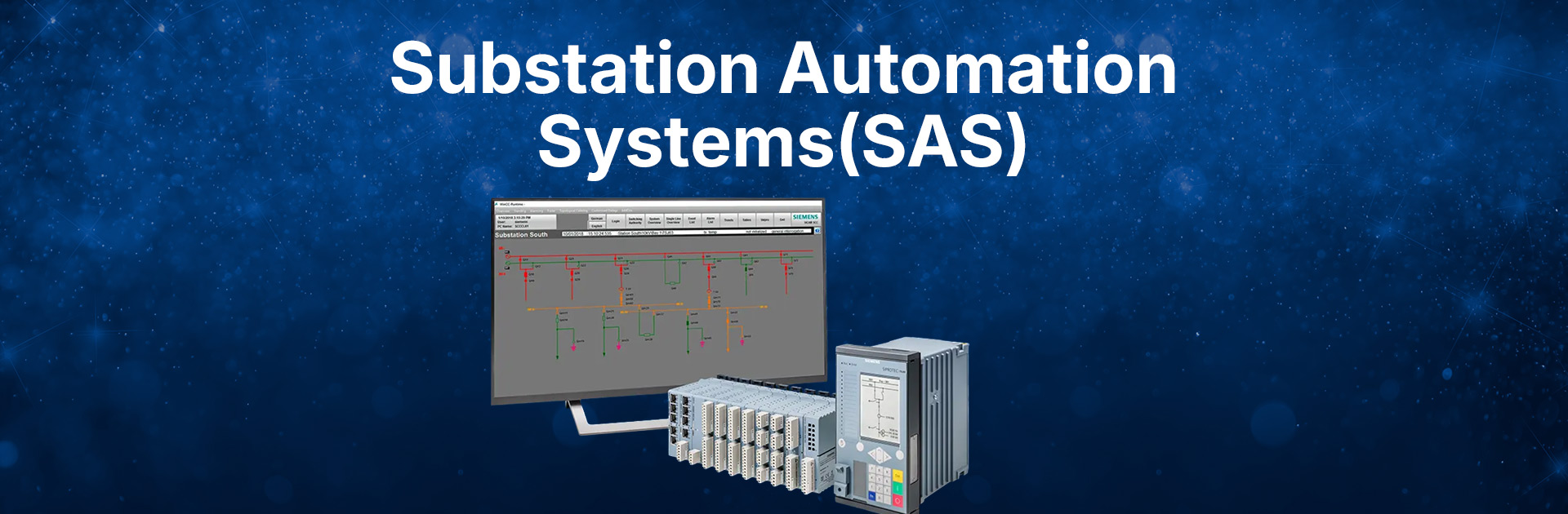
A Substation Automation System (SAS) is like providing a brain to a substation. It consists of an integrated system of hardware and software components designed to monitor, control, and protect electrical equipment at substations both locally and remotely, automatically.
For example, your thermostat in a smart home learns when to turn on or off heating or cooling, depending on your preference and outside conditions. On the other hand, a substation automation system will know when to reroute power, open or close circuit breakers, or shut down equipment in response to faults or changing grid conditions, all aimed at maintaining stability and preventing outages.
You might think: “Okay. But why should I care?”
Good question. Here’s why it matters. Not just for engineers. For everyone who uses electricity.
In old substations, when something breaks, it takes hours to fix. Hours to even find the problem. But with automation, the system finds issues in milliseconds. It takes action immediately. Power comes back faster. Outages are shorter.
Electricity is dangerous. Very dangerous. Walking into a live substation is risky for workers. Automation helps operators control circuits remotely. That’s why fewer people enter hazardous areas. That means fewer accidents.
Automated systems monitor equipment all the time. They spot early warning signs. Substation automation improves reliability by using intelligent electronic devices (IEDs), communication networks, and SCADA systems for real-time monitoring, automated fault detection, and rapid response, which helps prevent widespread outages and minimises downtime.
Modern grids are complex. They handle many energy sources. Coal, Solar, Wind, and Batteries. That’s why there is a lot to manage. Automation helps balance these sources in real time, so energy flows smoothly across the network.
Let’s talk about what makes up this system. A few key pieces work together like a team to make this system workable.
These are the labourers in the field. IEDs are smart sensors. They are attached to transformers, Circuit breakers, and Other equipment. They measure data, like Current, Voltage, and Temperature. According to this action, they execute commands, like opening the breaker or starting a backup system.
This part is quite cool. All the IEDs need to communicate with each other to the central control room. The issue is that they do not speak the same language. That’s why a communication gateway helps out. It translates data between devices. It brings everyone on the same page. Without it, you have smart devices that can’t communicate. Like having a smartphone with no internet.
SCADA refers to Supervisory Control and Data Acquisition. This is the main control centre. It helps operators to monitor the substation, remotely control breakers and switches, view real-time data, check data history, and analyse performance to optimise the system.
Simple way to think about it: SCADA is the brain that sees everything. IEDs are like other body parts for doing the actual work.
Digital substations utilise network-based communication, fibre optics, and modern technology instead of traditional copper wiring.
This makes faster data transfer, more reliable and easier communication. It’s like upgrading from an old phone to high-speed internet. Everything works better.
Let’s say a tree falls on a power line. Here’s what happens in an automated substation:
1. An IED detects something wrong. Maybe the voltage drops suddenly. Or there’s too much current.
2. It sends an alert to SCADA. Through the communication gateway.
3. SCADA analyses the problem. It decides which circuit breaker to open. To stop the fault from spreading.
4. The command goes back through the gateway. To the IED controlling that breaker.
5. The breaker opens. The fault is isolated.
6. The system reroutes power through another line. To keep electricity flowing.
All of this happens in seconds. Much faster than any human could do it.
What does this mean for common people?
1. More reliable electricity, like fewer outages and less downtime
2. Lower energy consumption, which means systems operate only when needed
3. Cleaner energy with better integration of renewable sources
4. Better storm response, which means faults are identified and fixed quickly
Substation automation is no longer an option. It is becoming a requirement. Renewable energy usage is growing. We need smarter systems.
The future will bring even better systems. Systems that use artificial intelligence predict equipment failures in advance to optimise energy flow in real time.
Developments in digital automation technologies and advanced communication systems make it possible. This transformation from traditional, manually operated facilities to smart, automated systems is crucial for managing the demands of modern power grids, especially with the rise of renewable energy sources and the need for greater efficiency and reliability.
While the term Substation Automation System (SAS) itself may sound complex, at its core, it is a simple idea about making electricity safer, more reliable and easier to manage.
The use of smart appliances, communication gateway systems, and digital substations technologies integrated with SCADA systems is focused on automation and reliable control of the power grid. Collective real-time data acquisition for effective monitoring is also incorporated.
Next time, when you switch off the light, just think there’s a whole network of smart technology working behind the scenes to make it happen.