


Solar energy relies on light and dirt blocks light. This ordinary fact creates a large problem for solar power plants. Dust, pollen, and bird droppings build up on panels over time and this build-up is called soiling. It reduces how much power a panel can make. Modern solar farms must track this loss to stay profitable. A dedicated soiling monitoring system provides the data needed to manage these losses.
Solar panels work best when their surfaces are clear. Particles on the glass reflect and absorb incoming sunlight. This prevents the solar cells from receiving full energy. Studies show that solar panel soiling loss can range from a few percent to over fifty percent in dusty regions. In some areas, just a thin layer of dust can drop energy production by 1% every day.
Large power plants lose thousands of dollars if they do not clean panels at the right time. Cleaning too often wastes money and water. Cleaning too late loses power revenue. Operators need to find the perfect balance. They use data to decide when the cost of cleaning is lower than the cost of lost power.
A soiling monitoring system typically uses two solar modules. One module is the reference. Workers or automated machines keep this module clean. The second module is the test module. This module stays dirty just like the rest of the solar farm. The system compares the electrical output of both panels.
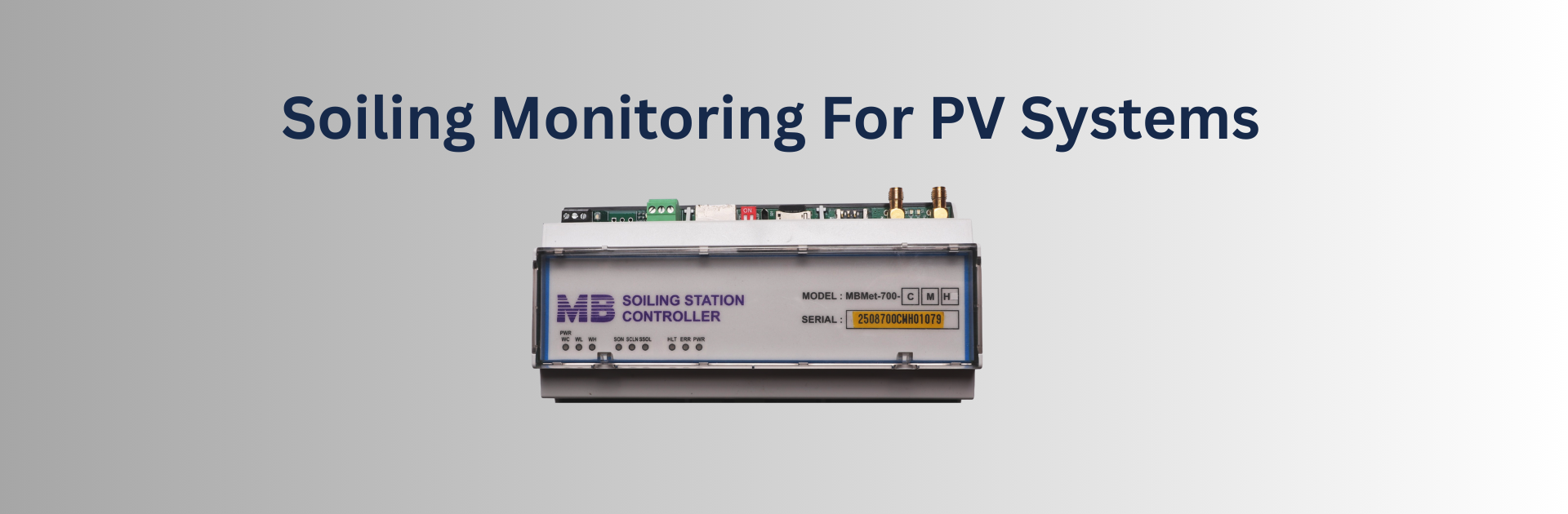
The Soiling Monitoring Station – MBMet-700 uses this exact method. It measures t
he short-circuit current and temperature of both panels. It then calculates the Soiling Ratio. This ratio tells the operator exactly how much power they are losing to dirt. The Soiling Monitoring Station – MBMet-700 is highly accurate. It has a measurement accuracy of 1%. This precision helps owners make better financial decisions.
The Soiling Monitoring Station – MBMet-700 provides several technical advantages for site operators:
– The station uses a 32-bit ARM processor for high-speed data calculations.
– It includes Class A PV module temperature sensors for precise thermal monitoring.
– The hardware fits into an IP65 enclosure to resist rain and dust.
– It comes with a three-meter heavy-duty mounting pole and a lightning arrestor.
– An internal SD card stores up to 16GB of data for local backup.
Modern energy management requires more than just looking at power meters. It requires a complete view of the environment. High-quality PV performance monitoring combines weather data with electrical data. This helps operators understand why production is low. Is it a cloudy day, or are the panels just dirty?
The MBMet-700 supports many communication protocols. It uses Modbus RTU, Modbus TCP/IP, and MQTT. It can even send data through cellular networks. This makes it easy to add to an existing SCADA system. The station stores historical data on an internal SD card. This ensures no data is lost during network outages.
The Soiling Monitoring Station – MBMet-700 is built for harsh outdoor environments. It uses advanced data filtering to remove bad data points. This occurs during rain or low light. This makes the solar panel soiling loss calculations more reliable. Users can access a built-in web server to check real-time data or change settings. No special software is needed.
Manual inspections are slow and often wrong. A technician might look at one corner of a plant and assume the whole site is clean. A soiling monitoring system provides a site-wide average. This leads to automated cleaning decisions.
In some cases, the Soiling Monitoring Station – MBMet-700 can control cleaning equipment directly. It has digital inputs for water level monitoring and can trigger pumps or valves. This moves the plant toward fully automated maintenance. Automated systems reduce labor costs and keep panels at peak performance.
Modern solar projects last for twenty-five years or more. Monitoring equipment must last just as long. MB Control & Systems has built industrial automation tools since 1983. The MBMet-700 reflects this experience.
– The system is compliant with IEC 61724-1 standards for weather monitoring.
– It includes built-in surge protection to prevent damage from electrical spikes.
– The design supports both 35W and 100W solar modules as per site needs.
– The system works in a wide temperature range from -5 to +70 degrees Celsius.
Data is only useful if it reaches the decision-makers. The MBMet-700 offers flexible networking. It includes an optional 4G modem for remote sites. Operators can use FTP to pull logged files to their own servers. The station also supports SNTP for time synchronization. This ensures that every data point has a correct timestamp.
The Soiling Monitoring Station – MBMet-700 is a versatile tool. It works for rooftop systems and large utility-scale plants. It helps reduce the uncertainty in energy estimates. This makes solar projects more attractive to investors. When risk is lower, the cost of capital goes down.
Reliable PV performance monitoring does more than just measure dirt. The Soiling Monitoring Station – MBMet-700 collects data on all surrounding weather conditions. It acts as a central hub for several sensors. These sensors give a clear view of how the environment affects the solar plant.
– Wind Speed and Direction: High winds can deposit more dust or even cause structural stress.
– Ambient Temperature and Humidity: These factors influence the efficiency of the silicon cells and the rate of dust adhesion.
– Global Horizontal Irradiance (GHI): This is the total amount of sunlight hitting a flat surface. Operators compare this number to the actual power produced. This comparison shows the true efficiency of the plant.
– Rainfall Detection: Rain can act as a natural cleaning agent, and the station tracks these events to reset the soiling calculation.
By centralizing this data, the Soiling Monitoring Station – MBMet-700 helps operators build a digital twin of their facility. This leads to better long-term forecasting.
Financial models for solar plants often underestimate solar panel soiling loss. This leads to gaps between expected and actual revenue. A soiling monitoring system removes this guesswork. For a 100MW plant, a 1% improvement in accuracy can represent tens of thousands of dollars in annual profit.
The data from the MBMet-700 helps in legal and warranty claims. If a manufacturer claims a certain efficiency, the owner can prove that losses are due to environment rather than hardware failure. This data-driven transparency builds trust between project owners and grid operators.
The solar industry is growing fast. New plants are being built in deserts and industrial zones. These areas have high dust levels. In these locations, a soiling monitoring system is not an option. It is a requirement.
Tracking solar panel soiling loss allows for predictive maintenance. Instead of reacting to a drop in power, operators can plan ahead. They can watch the dust build up and schedule a cleaning crew for the next week. This proactive approach keeps the grid stable.
Using a Soiling Monitoring Station – MBMet-700 ensures that every ray of sun is captured, it protects the hardware and the investment. Remember, high-quality PV performance monitoring is the best way to ensure long-term success for any solar project.
What is a Soiling Ratio?
The Soiling Ratio is a number that compares the energy from a dirty panel to a clean one. A ratio of 1.0 means the panel is perfectly clean. A ratio of 0.95 means dirt is causing a 5% loss in power.
How does the MBMet-700 handle data during a power failure?
The station includes a clock that stays accurate during power outages. It saves measurements on an internal SD card with 16GB of space. This storage prevents data loss if the network fails. The information stays safe until the connection returns.
Can the system work with full-sized solar panels?
Yes. The Soiling Monitoring Station – MBMet-700 is compatible with small modules and full-sized PV modules. This allows it to match the specific panels used on the rest of the solar farm.